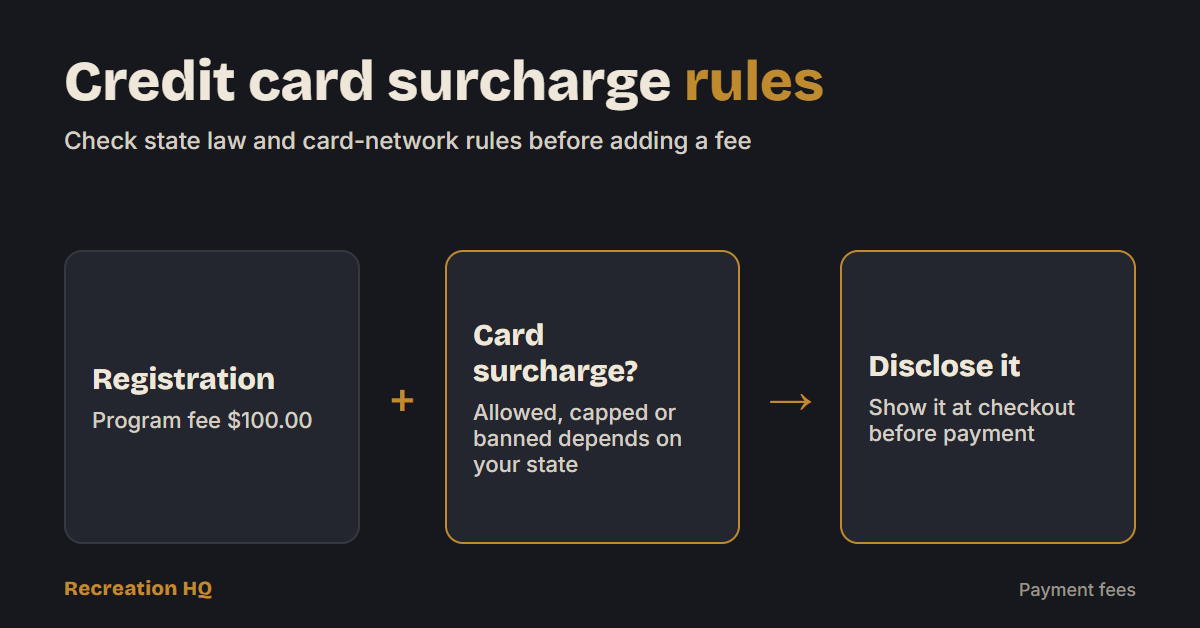
Before a recreation department adds a fee at checkout, it needs to understand credit card surcharge rules. A resident registers a child for soccer, enters a card number, and sees a charge higher than the posted program fee. The front desk gets the call before lunch: what is this fee, can I avoid it, and why does a city program charge it at all?
The question is reasonable. Visa explains that merchants negotiate and pay a merchant discount to their financial institution, typically calculated as a percentage per transaction, so departments need a policy for carrying that cost. How the fee is described, calculated, displayed, and applied matters as much as the rate. The goal is not to hide a cost in a checkout screen. It is to make a consistent, understandable decision that your attorney has reviewed.
Know the parties behind one card payment
A card payment involves more than the recreation department and the resident. Visa describes interchange as transfer fees between acquiring banks and issuing banks, says merchants do not pay interchange directly, and notes that a variety of processing services may be included in a merchant discount rate.
As general advice, treat "our processing rate" as the start of the conversation, not the answer. Ask for the full schedule in writing and have the provider state whether there is a fixed per-transaction amount on top of any percentage, and whether refunds, disputes, payment-plan installments, or particular card types carry separate charges. Note when each charge applies and who receives it.
As general advice, ask for software pricing and payment processing to be quoted separately where possible. Finance should be able to identify the effective processing cost and any platform charge connected to it. Our recreation software cost breakdown shows how to separate the line items, and PCI compliance for recreation payments covers the security side of taking cards.
Read the schedule as an operating document
This section is general advice, not a sourced finding. Do not review the payment schedule only at contract signing. Your registrar, finance staff, and customer-service team need to understand it. Start with four questions.
- Is the fee calculated on the program price alone, or on the total including taxes, discounts, prior fees, and installments?
- Does the rate differ by payment method, card type, online versus in-person payment, or transaction size?
- What happens to the fee when a registration is refunded, canceled, disputed, or partially credited?
- When are funds settled to the department, and how do gross payments, fees, refunds, and chargebacks reconcile to the deposit?
Read the definitions, not only the headline rate. Ask how the contract defines a transaction, whether the original processing charge comes back when you refund a registration, and what a chargeback costs and how long you have to respond. Your written refund policy should match what the payment arrangement actually permits.
Ask for a sample settlement report. It should let staff tie a day's registrations to gross card receipts, processor deductions, refunds, disputes, and the net bank deposit. If staff cannot explain the difference between the registration report and the deposit, the schedule is not yet operationally usable.
Credit card surcharge rules: decide who pays before configuring checkout
There are three broad ways to handle card costs: absorb them in the program budget, charge a broadly applicable service fee, or add a charge tied to a payment method. The options are general advice; the rules that apply to each depend on your state, your card networks, and local policy, so confirm them before choosing.
Visa's merchant surcharge Q&A says merchants in most U.S. states and territories may add a surcharge to credit card transactions, subject to certain limitations, and that Visa understands some state laws prohibit or limit surcharging. The Q&A sets out Visa's requirements, so ask your processor how any other card brands you accept treat surcharges. As of its February 2024 version, Visa said it understood that Connecticut, Maine, Massachusetts, Oklahoma, and Puerto Rico prohibit surcharging, and that Colorado, Minnesota, New Jersey, and New York have requirements for it. Visa notes that its understanding may contain errors and is not legal advice, and the Q&A adds that it may not reflect the most current legal developments, so treat that list as a prompt to ask your attorney, not as an answer.
Where surcharging is allowed, Visa requires that it apply to credit cards only, that debit and prepaid cards cannot be surcharged, and that the amount not exceed the merchant discount rate for that card or 3 percent, whichever is lowest. The merchant must notify its acquirer at least 30 days before starting (see Visa's merchant surcharging page) and clearly disclose the surcharge, per the Q&A, at the point of entry, the point of sale, and on every receipt. Have your city attorney, finance director, and payment provider review the practice before launch.
State statutes are where the detail sits, and they can treat public agencies differently. Massachusetts law says no seller in any sales transaction may impose a surcharge on a cardholder who elects to use a credit card instead of cash, check, or similar means. Maine law generally bars sellers from surcharging credit or debit card users, but a separate subsection lets a governmental entity impose a surcharge on card payments for items including registration fees, provided it is disclosed clearly before payment and does not exceed the card costs directly incurred by the entity or assessed by an authorized third-party payment service provider. Maine also requires the entity to tell residents the surcharge can be avoided by paying another way. As general advice, read your own state's statute alongside the card network rules rather than relying on either alone.
In our view, absorbing the cost is often the simplest resident experience. The posted program fee is what a household pays whether it uses a card, check, or cash, and the department budgets processing as an operating expense. The tradeoff is that general program revenue or public support carries the cost, which matters if you are tracking cost recovery.
As general advice, a broadly applied service fee is a way to spread an administrative cost across users. Get written confirmation from counsel that it fits your state law, local policy, and card network rules. If you choose it, decide whether it applies to every payment method and every program. In our view, a fee charged inconsistently is hard to explain and creates exceptions at the counter. A payment-method-specific charge requires the most careful review. Do not configure it because another agency does; confirm your own authority in writing.
Fairness is a policy question, not only a math question
Passing a fee to registrants looks neutral on a spreadsheet, but it can affect households differently. As general advice, work out what any fixed per-payment amount in your schedule represents as a share of your lowest-priced program and of your highest-priced one, and ask your provider whether each installment of a payment plan is charged separately.
As a hypothetical, a department might offer a low-cost drop-in class, a weeklong camp, and a scholarship-supported activity. Work out what the same fixed fee would add to each. Model the amount displayed at checkout, not only the annual revenue the fee could generate.
Consider access alternatives that fit local policy: an in-person payment option, a waiver for approved scholarship participants, or absorbing the charge for selected services. Document who is eligible, who approves exceptions, and how the decision is recorded. In our view, a quietly improvised exception at the front desk is not an equitable policy.
Be careful with refunds. If your department keeps a processing cost after a resident cancels, say so in the published refund policy before payment, and make sure the system applies the same rule residents see online.
Make checkout transparent
A resident should see the program price, discount, any applicable fee, and final total before authorizing payment. Use labels a reasonable person can understand, subject to the terminology your legal and finance teams approve. For a step-by-step review of the rest of the checkout flow, use the registration friction audit.
Put the policy where residents can find it before the final screen: the fee schedule, registration help page, confirmation email, and staff reference materials, all with the same wording. If the system allows different rules by program or payment method, test the public view of every path before opening registration.
Train staff with a short script and a clear escalation path. They should explain the adopted policy without speculating about card rules or granting exceptions they are not authorized to make.
Review the policy after a season
After a registration cycle, look beyond fee revenue. Review payment-method use, abandoned carts if available, customer questions, refunds, scholarship participation, counter-payment volume, and reconciliation issues, then compare what the policy was expected to do with what happened. If a fee produces confusion, staff workarounds, or an access concern, bring that evidence back to the policy owner. The answer may be clearer disclosure, a revised exception, a different allocation of cost, or no change. Our guide to revenue leakage covers related reconciliation checks.
Frequently asked questions
What are the credit card surcharge rules for a parks and recreation department?
Visa's merchant Q&A says merchants in most U.S. states and territories may add a surcharge to credit card transactions, subject to certain limitations, and that some state laws prohibit or limit it. The Q&A covers Visa's requirements and says it is not legal advice, so confirm your state law with your city attorney before you configure anything.
Can you surcharge debit card registrations?
No. Visa's rules say debit and prepaid cards cannot be surcharged, even when the cardholder chooses "credit" on the terminal.
What is the maximum credit card surcharge?
Under Visa's rules the surcharge cannot exceed the merchant discount rate for that credit card or 3 percent, whichever is lowest. It must also be clearly disclosed at the point of entry, the point of sale, and on every receipt.
How should a recreation department handle processing fees if surcharging is not allowed?
As general advice, a department can absorb the cost in its program budget or build it into the posted program fee. Visa's Q&A separately describes a cash discount as a permitted alternative only if prices are shown as the card price alone or as card and cash prices side by side, so have counsel and your processor review the display before launch.
Find your leaks
See what your organization could recover.
A 20-minute audit, your numbers, no obligation.
Get my cost-recovery audit →Or get one practical playbook like this by email, every week.